ABDOMINAL CONTOURING · NORTH ALABAMA
Full Tummy Tuck in Decatur, Alabama
Understand full abdominoplasty, compare historical before-and-after examples, and plan for scars, abdominal-wall repair, recovery, and costs.
A full tummy tuck reshapes the abdomen by removing excess skin and fat. It may also include repair of weakened or separated abdominal-wall tissue. Unlike a mini tummy tuck, a full procedure can address more extensive skin looseness above and below the belly button. [1][3][4]
This guide explains what to discuss before choosing full abdominoplasty in Decatur, AL. It includes original illustrations and historical photo comparisons, along with questions for consultations in Decatur, Huntsville, or Athens.
About this website: We are an independent information resource, not a medical practice, and are not affiliated with the former practice at this domain. We currently do not book appointments or have participating clinicians. This guide provides general education; your clinician determines what is appropriate for you.
ON THIS PAGE
- Full tummy tuck and other options
- Candidacy and timing
- The operation and diagrams
- Before and after photos
- C-section scars
- Combining procedures
- Surgery after major weight loss
- Preparing for surgery
- Recovery and time off work
- Risks and warning signs
- Costs and insurance
- Choosing a local surgeon
- Consultation checklist
- Common questions
Full tummy tuck and other options
A useful consultation separates the effects of loose skin, fat beneath the skin, and abdominal-wall laxity. Removing one does not necessarily correct the others. The operation should match the concern rather than simply offer the shortest scar.
- Full abdominoplasty: removes excess abdominal skin and fat, with abdominal-wall repair when appropriate. It generally involves a low abdominal incision and an incision around the navel. [3]
- Mini tummy tuck: treats a more limited area below the navel and may suit selected lower-abdominal concerns. See the mini-abdominoplasty guide. [4]
- Liposuction: removes localized fat but does not remove hanging skin. It may be considered alone or as an additional procedure. See the liposuction guide. [5]
- Panniculectomy: removes an overhanging apron of lower-abdominal skin and fat. It typically does not include abdominal muscle tightening and has a different purpose from a full contouring operation. [14]
A tummy tuck is not a weight-loss treatment. It can remove stretch marks only when they are on skin being removed; it cannot erase all abdominal stretch marks. Substantial weight changes or a future pregnancy can also change the result. [1]
Candidacy and timing
Typical candidates are in good health, have a stable weight, do not smoke, and have realistic expectations. The surgeon should examine the whole abdomen and discuss your priorities, previous operations, and the amount and distribution of excess skin. [6]
Discuss plans for pregnancy or further weight loss before scheduling surgery. Medical conditions, blood-clot risk, smoking, and previous abdominal scarring can affect whether and when an operation is appropriate. [2]
After substantial weight loss, ask whether a standard tummy tuck will address the areas that concern you or whether a different incision pattern is needed. More extensive skin laxity may require additional scars, such as a vertical component. A smaller operation can leave some concerns untreated. [4]
Incisions, muscle repair, and the belly button
In a standard full tummy tuck, the surgeon removes selected lower-abdominal skin and fat, brings the remaining skin downward, and closes the lower incision. The navel is brought through an opening in the repositioned skin. The amount of skin to be removed helps determine the incision’s shape and length. [3]
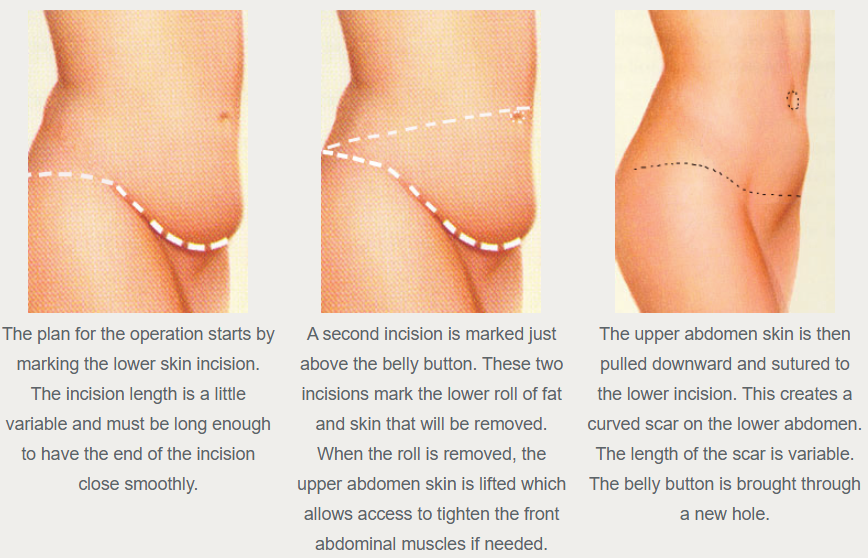
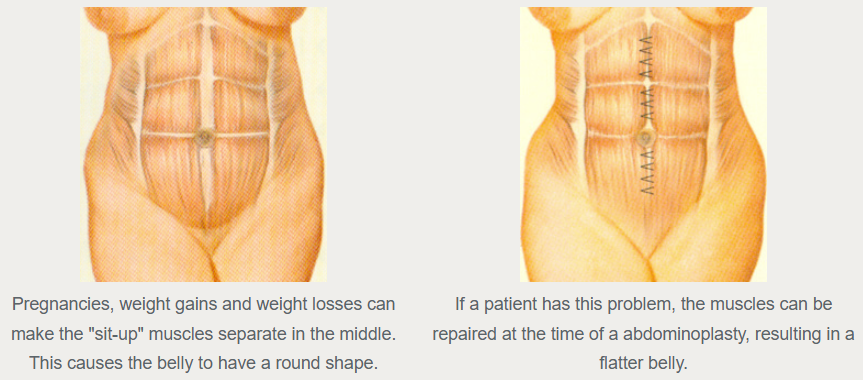
What is often called “muscle tightening” usually involves tightening the connective tissue, or fascia, over the abdominal muscles with stitches. When the rectus muscles are separated, this can bring their positions closer together. Whether repair is needed should be established during assessment. [2]
Liposuction of the waist or flanks may be proposed as an additional step. Ask which areas are included, whether they will be treated at the same operation, and how that affects cost and recovery. The historical article’s routine approach is not a requirement for every full tummy tuck.
Expect a lasting lower-abdominal scar and usually a scar around the navel. A previous C-section scar may sometimes be incorporated into the new incision. Scar appearance changes during healing; another operation may occasionally be needed to improve a result. [19]
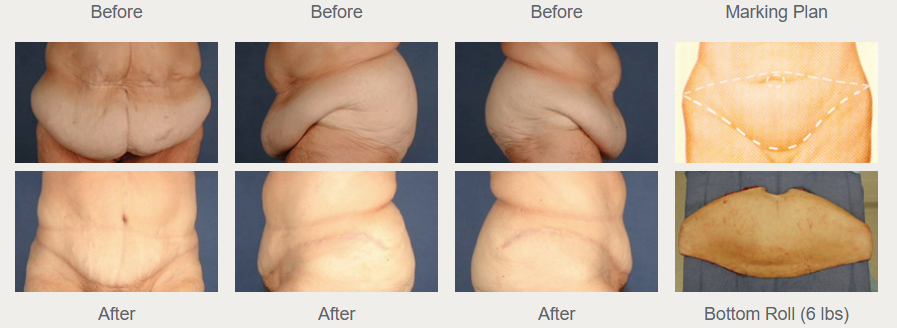
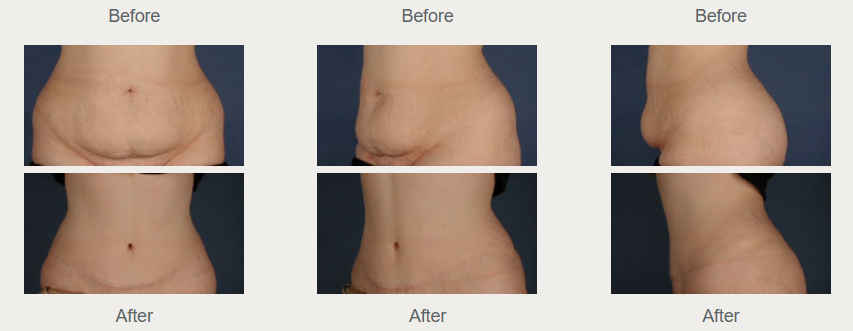
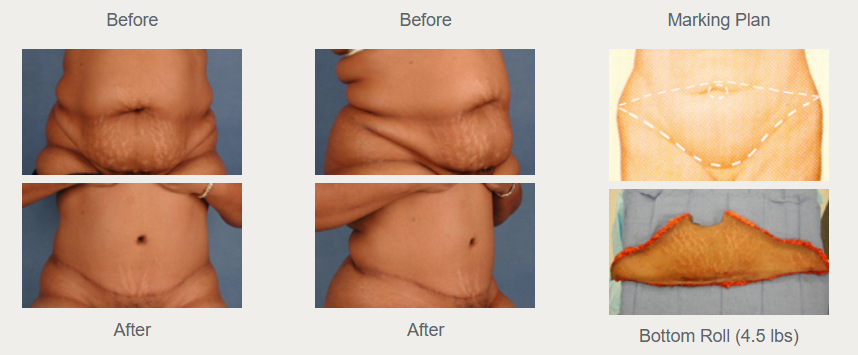
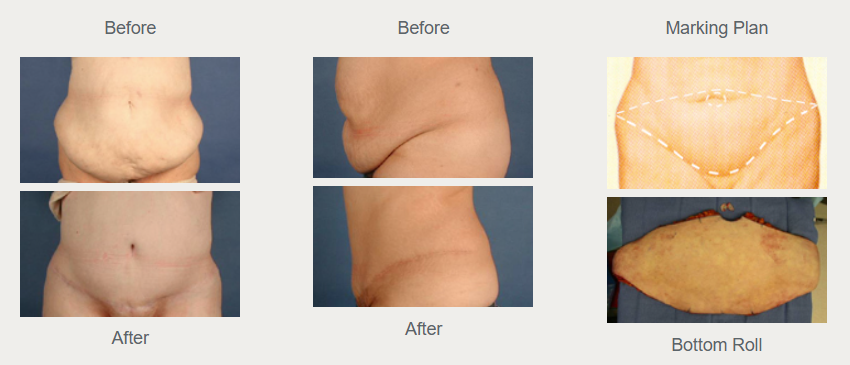
Full tummy tuck before and after photos
These original screenshots retain their labels, lighting, and layout. The historical page describes the after images as taken at approximately 12 months; that timing and the complete operative details have not been independently verified. Some montages include removed tissue and surgical-marking diagrams.
These are historical examples, not a prediction of your result or evidence of services offered by this website today. Posture, lighting, and camera angle can affect comparisons. Tissue-weight labels describe an individual case, not an expected amount of weight loss. Select any image to view the original at full size.
What about an indented C-section scar?
The original page includes the following example of a lower-abdominal contour change associated with an emergency C-section scar. Its caption uses informal language; the relevant consultation question is how the scar, surrounding skin, and abdominal contour might be addressed.
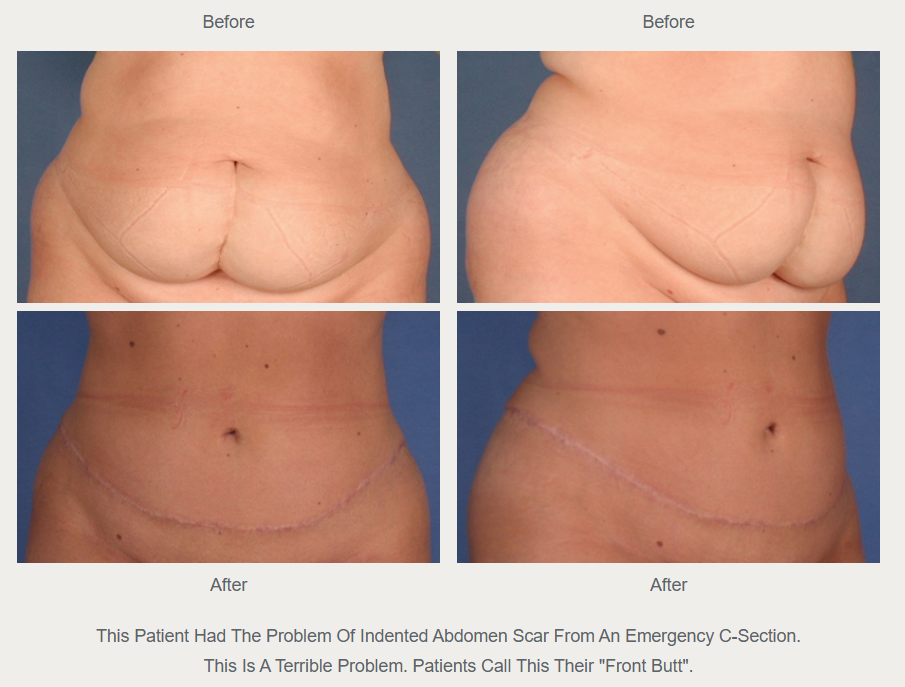
A tummy tuck may incorporate an existing C-section scar into the new scar, but that is not possible in every situation. Previous surgery can also limit the achievable result. Ask what would happen to your particular scar and which irregularities might remain. [19]
Combining a tummy tuck with another operation
The two original sets below are labeled as abdominoplasty performed during the same operative setting as hysterectomy. They document historical combined cases; they do not show that a combined approach is right for everyone.
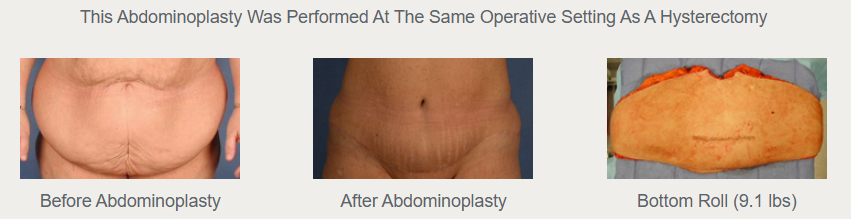
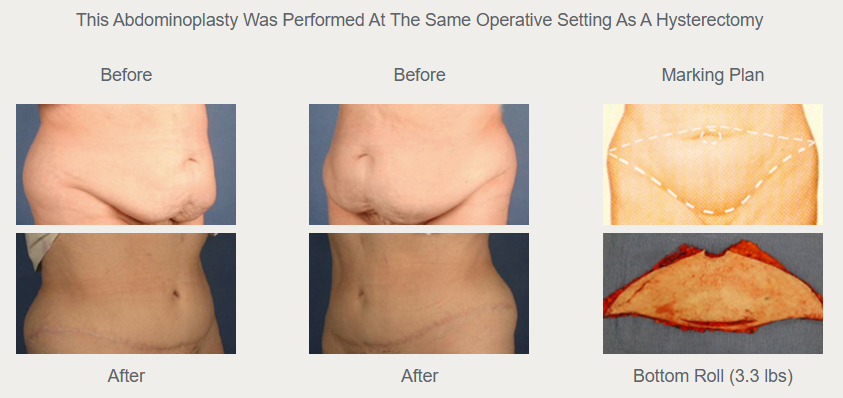
If you are considering abdominal contouring with breast surgery or a gynecologic procedure, ask the relevant surgeons and anesthesia team to compare a combined operation with separate procedures. Discuss total operating time, recovery needs, and responsibility for follow-up. Clarify coverage for each component instead of assuming that a medically indicated procedure makes the cosmetic portion covered. [13]
Tummy tuck after major weight loss
After major weight loss, the concern may be an overhanging apron of skin, looseness extending around the waist, or both. Ask whether the proposed operation is a panniculectomy, a full tummy tuck, or a more extensive body-contouring procedure. These names should be tied to a clear explanation of what will be treated. [14][4]
About the next image’s insurance caption: it describes one historical patient’s reported coverage after gastric bypass and skin irritation. It is not a current insurer’s policy, and those features alone do not establish your eligibility. Confirm the exact procedure and your plan’s requirements before surgery. [15]
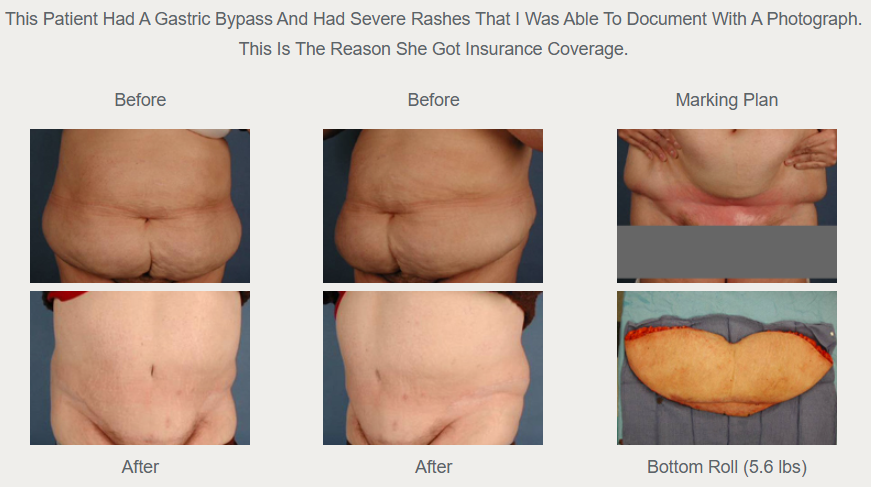
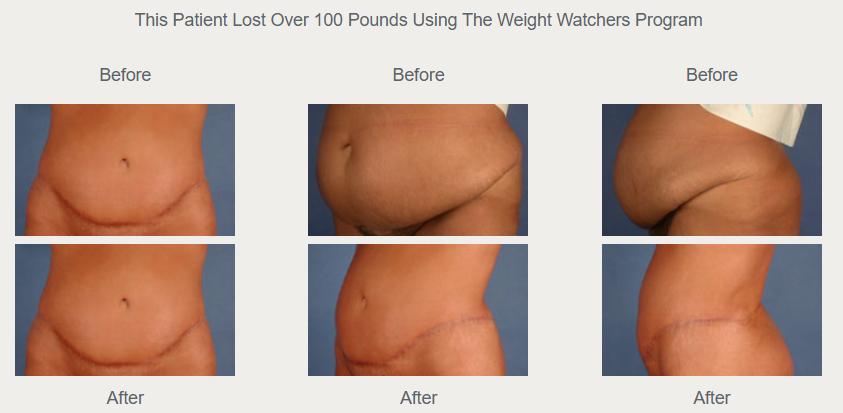
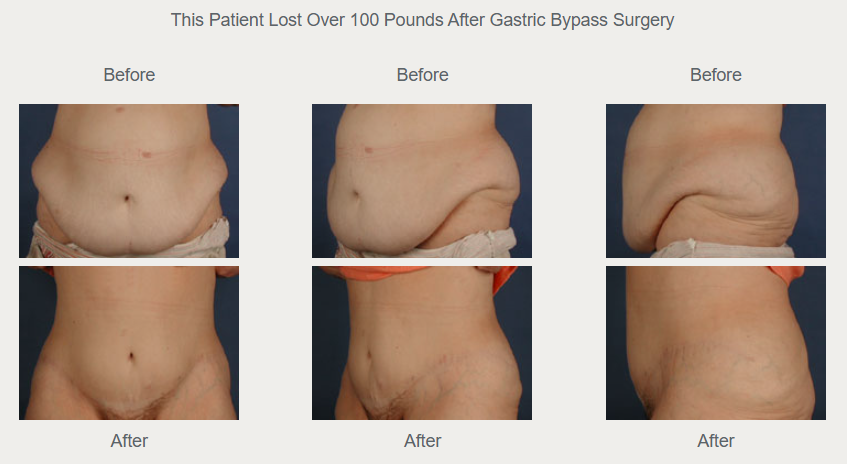
The captions describe each historical case and do not recommend one weight-loss method. If you are still losing weight, discuss timing and nutritional readiness with your clinicians. The body contouring overview explains related procedures for other areas.
Preparing for surgery
Preparation may include a medical assessment, laboratory tests, smoking cessation, and a review of medicines and supplements. Provide a complete list, including weight-management medicines, and let your prescriber and surgical team coordinate changes. Do not stop a prescription on your own. [7]
Confirm where surgery will take place, the anesthesia plan, and whether a hospital stay is expected. The old article’s named hospital, three-hour operating time, and same-day discharge were descriptions of a former practice, not a current arrangement offered by this website.
- Arrange a responsible adult to drive you home and help during early recovery.
- Plan help with childcare, pets, groceries, household tasks, and anything requiring lifting.
- Get the written instructions for fasting, medicines, wound care, walking, and follow-up.
- Ask how to reach the team after hours and where urgent assessment would happen.
Your surgeon should explain how these arrangements fit your actual operation and health. Arrange time away from work with flexibility for slower healing or additional visits. [7][8]
Recovery and time away from work
Expect an early period of soreness, swelling, bruising, and tightness. Movement may feel uncomfortable, and abdominal-wall repair can change the recovery plan. Ask how pain will be managed and what to do if the prescribed approach is not enough; a fixed medication schedule from an older article is not a personal plan. [9]
- Dressings and support: follow the team’s instructions for incision care and any compression garment. Ask about comfortable positioning and safe movement. [8]
- Drains, if used: learn what to record, how to care for them, and whom to call. There is no universal requirement for the three or four drains described in the old article; some techniques can avoid drains. [2][8]
- Work: agree on a return date based on your duties, commuting, pain control, and healing. Physical work may require modified duties or additional time away.
- Exercise and lifting: general tummy-tuck guidance from Cleveland Clinic describes avoiding strenuous exercise for four to six weeks. This is not automatic clearance; your surgeon may require longer restrictions depending on the repair and healing. [9]
The NHS gives a broader planning estimate of about four to six weeks away from work and exercise for tummy-tuck recovery. These published ranges are planning context, not a promise. Get explicit instructions for driving, lifting children, gym activity, showering, and any garment or drain care. [10]
Attend the follow-up visits your team schedules. Swelling can obscure the early contour, and scar fading takes months. Feeling ready for desk work does not mean the deeper tissues are ready for heavy lifting. [19]
Risks and warning signs
Possible complications include bleeding, infection, fluid collections, wound-healing problems, skin or fat damage, numbness, persistent pain, asymmetry, unfavorable scars, and the need for another operation. Blood clots and anesthesia-related complications are also possible. Ask which risks matter most for your own health and proposed surgery. [11]
Contact the surgical team promptly about severe or worsening pain, excessive bleeding, significant swelling, or drainage that looks like pus. Obtain a written plan for urgent problems before going home. [9]
Call 911 for new chest pain, sudden shortness of breath, or fainting. These can signal a serious complication, including a blood clot in the lungs, and need immediate assessment. [12]
Costs and insurance
Ask for an itemized quote covering the surgeon, anesthesia, facility, tests, medicines, garments, and expected follow-up. Clarify whether liposuction or any additional procedure is included, and what happens financially if further care or revision is needed. [13]
Cosmetic abdominoplasty is generally self-funded. ASPS notes that most health insurance plans do not cover tummy-tuck surgery or its complications. A national average is not a Decatur price quote, and a surgeon-only fee is not the complete cost. [13]
A panniculectomy may be covered in some circumstances, but it is not the same operation as a full cosmetic tummy tuck. Ask the insurer and surgeon about the exact planned procedure, documentation, authorization requirements, and out-of-pocket charges. Do not rely on the old page’s photograph-based criteria as a guarantee of coverage. [14][15]
Choosing a surgeon in Decatur, Huntsville, or Athens
Ask about experience with full abdominoplasty, abdominal-wall repair, and patients whose anatomy and goals resemble yours. Request an explanation of scar placement, alternatives, and the likely limits of the result.
For physicians, check license information and available public actions through the Alabama medical board’s licensee search. A listed specialty is not independent verification of board certification. Check a claimed plastic-surgery certification with the American Board of Plastic Surgery directly. [16][17]
Confirm the facility and anesthesia arrangements. ASPS requires its members to operate in accredited, state-licensed, or Medicare-certified surgical facilities. If you travel to Huntsville or Athens, plan for follow-up and urgent assessment as well as the operation itself. [18]
Common questions
Does every full tummy tuck require muscle repair?
No. The original article describes operations with and without tightening. Ask whether abdominal-wall repair is part of your plan, why it is proposed, and how it affects recovery.
Will my belly button look different?
It may. A standard full tummy tuck brings the navel through an opening in the repositioned abdominal skin. Discuss its likely shape, surrounding scar, and any limitations created by previous surgery. [3]
Will it remove all stretch marks?
No. Stretch marks on removed skin may disappear with that skin, but those elsewhere remain. Ask the surgeon to show which areas would be removed and which would stay. [1]
Sources and further reading
Medical resources checked September 21, 2026. This guide updates the supplied historical article and retains its original image captions as historical material. Those captions are not current treatment or insurance instructions. This page has not been reviewed by a clinician on behalf of this website.
- American Society of Plastic Surgeons. Tummy tuck overview and limitations.
- Mayo Clinic. Tummy tuck.
- American Society of Plastic Surgeons. Tummy tuck procedure steps.
- American Society of Plastic Surgeons. There’s more than one type of tummy tuck.
- American Society of Plastic Surgeons. Liposuction overview.
- American Society of Plastic Surgeons. Tummy tuck candidates.
- American Society of Plastic Surgeons. Preparing for tummy tuck surgery.
- American Society of Plastic Surgeons. Tummy tuck recovery.
- Cleveland Clinic. Tummy tuck: surgery, recovery, risks, and results.
- NHS. Tummy tuck (abdominoplasty).
- American Society of Plastic Surgeons. Tummy tuck risks and safety.
- MedlinePlus, U.S. National Library of Medicine. Pulmonary embolism.
- American Society of Plastic Surgeons. Tummy tuck cost.
- American Society of Plastic Surgeons. Panniculectomy overview.
- American Society of Plastic Surgeons. Panniculectomy cost and insurance.
- Alabama Board of Medical Examiners and Medical Licensure Commission. Licensee search.
- American Board of Plastic Surgery. Verify certification.
- American Society of Plastic Surgeons. ASPS member qualifications.
- American Society of Plastic Surgeons. Tummy tuck results and scars.