
EARLOBE REPAIR · NORTH ALABAMA
Earlobe Repair in Decatur, Alabama
A guide to repairing torn or stretched ear piercings, with the original illustration and practical advice on healing, scars, repiercing, and costs.
Earlobe repair can close a stretched piercing hole or reconnect a split lobe. The operation, also called lobuloplasty, often takes place in an office using local anesthetic. The plan depends on the tear, the remaining tissue, and the shape you want to restore. [1]
This guide is for people considering pierced earlobe repair in Decatur, Alabama, or nearby Huntsville and Athens. It explains the repair shown in the original website’s illustration and the questions to ask before arranging treatment.
ON THIS PAGE
- Stretched holes and split earlobes
- Original repair illustration
- Consultation and preparation
- How earlobe repair works
- Healing and wound care
- Work and daily activities
- When can ears be pierced again?
- Scars and keloid concerns
- Risks and warning signs
- Costs and insurance
- Choosing a local clinician
- Consultation checklist
- Common questions
Stretched piercing holes and split earlobes
Heavy earrings can gradually lengthen a piercing, and an earring caught on clothing or pulled suddenly can tear through the bottom of the lobe. Gauges, closely spaced piercings, and holes near the lobe’s edge may also contribute to damage. [2]
A stretched opening may make an earring tilt downward or sit unevenly. A complete split creates a gap through the lower border. Explain whether your main concern is the opening, the overall shape, matching the other ear, or eventually wearing earrings again.
Enlarged gauge openings and lobes with missing tissue may need a different reconstruction from a small split. The clinician should assess the available tissue and discuss the likely contour after closure. Some repairs require rearranging tissue rather than simply joining two edges. [2][3]
A fresh tear needs a different assessment
If an earring has just torn through the ear, seek prompt medical care rather than waiting for a routine cosmetic consultation. Fresh lacerations need assessment for wound closure and infection risk. A near-detached lobe, crush injury, or injury involving other parts of the ear may need specialist treatment. [7]
This page concerns the soft earlobe. For information about bringing prominent ears closer to the head, see our otoplasty and ear pinning guide.
Original earlobe repair illustration
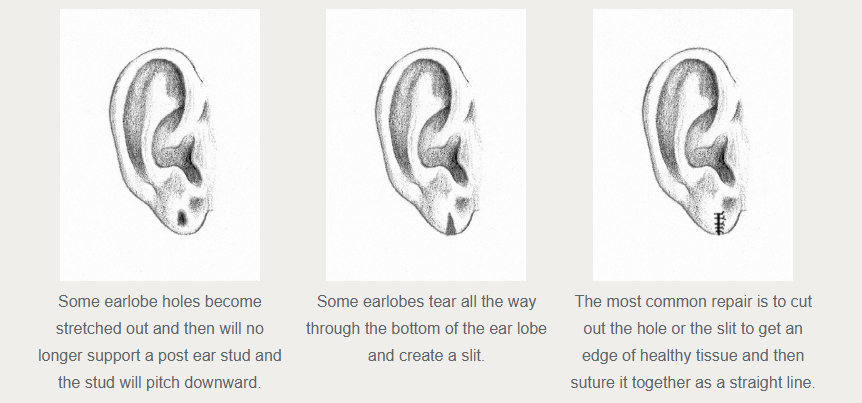
The first panel shows a piercing that no longer supports an earring well. The second shows a full tear through the lower edge. The third illustrates removing the lining of the old opening and joining fresh tissue edges. The final closure and scar pattern depend on the defect and chosen technique.
Consultation and preparation
The consultation should cover how the damage occurred, your goals, and any previous repair. Bring a list of medicines and supplements and mention diabetes, smoking, and other factors that could affect bleeding or healing. [2]
Tell the clinician about previous raised scars or keloids, including any family history. Keloids are overgrowths of scar tissue that can follow a piercing or surgery; they may require a separate treatment plan. [5]
Ask whether one or both ears need treatment and how closely their shapes can be matched. If you want to keep wearing earrings, make that part of the discussion before surgery. Confirm whether the old opening will be closed and who will advise on a future piercing.
Get individualized instructions for medicines, smoking, and jewelry before the appointment. Do not stop prescribed aspirin, blood thinners, or other medicines on your own; any change should be coordinated with the prescribing clinician. [1]
How pierced earlobe repair works
For a typical repair, the clinician numbs the area, removes the healed lining or scar at the defect, and brings the tissue edges together with fine stitches. A straightforward closure usually removes the old piercing opening. Other designs may be used to preserve shape or manage more complex defects. [3]
The supplied historical article describes an office procedure with local anesthesia and a small dressing afterward. Ask your current clinician how your repair would be performed, how long the appointment will take, and whether you need someone to drive you home.
A straight closure is one option, as the drawing shows. Published surgical descriptions also discuss tissue-flap techniques and approaches to recurrent tears. Ask why the proposed design suits your lobe, particularly if there is a thin lower edge, an old repair, or a large stretched opening. [3]
The goal should include the contour of the lower edge as well as closure of the hole. Ask where the scar will sit and what difference in lobe size or shape may remain. A smaller hole and a large gauge defect should not be assumed to need identical treatment.
Healing and wound care
Some tenderness, swelling, bruising, or temporary numbness may occur. Follow the clinician’s advice on pain relief. The surface can look improved before healing is complete, so continue protecting the lobe for the period recommended. [1]
Ask how to clean the repair, which dressing to use, and when it can get wet. Wash your hands before wound care. Use ointment or other products only as instructed, and avoid rubbing or soaking the incision while it heals. [4]
If the stitches need removal, published repair guidance describes follow-up around seven to fourteen days. The timing depends on the closure and healing; dissolving stitches may be used instead. Confirm the plan before leaving the appointment. [7]
The original page allowed showering the next morning. Treat your own clinician’s instructions as the guide, especially if a dressing must stay dry. Do not pick at stitches or try to remove them yourself. [4]
Before you leave, ask for written care instructions and a contact number. Include practical questions about hair washing, sleeping position, and anything you routinely wear around the ears.
Time off work and daily activities
Many people having a straightforward office repair return to work the same day or the following day, according to an ASPS-hosted surgeon article. Your job, the repair, and any medicines used may change that advice. [2]
Tell the clinician if work involves a helmet, ear protection, headset, or anything that presses on the lobe. Discuss exercise, swimming, and activities where the ear could be bumped or pulled. Ask for separate guidance on driving if any sedating medicine is planned.
Plan clothing and grooming around the repair: a tight neckline, hairbrush, or accessory can catch the area. Ask when it is safe to resume your usual routines. Being able to work does not mean the lobe is ready for earrings or another piercing.
When can the ear be pierced again?
Wait for clearance from the treating clinician. Cleveland Clinic describes a typical wait of three to six months and recommends placing the new piercing at least 3 millimeters from the treated area. The safe location depends on the healed scar and remaining tissue. [1]
The old article’s fixed two-month interval should not be treated as permission to repierce. Have the repair examined first, ask the clinician to identify a suitable location, and tell the professional piercer about the operation.
Ask about the weight and style of jewelry after clearance. Heavy earrings can put renewed strain on the lobe, and avoiding them is part of preventing another split. A repaired ear can be injured again. [7]
If you or a blood relative develop keloids, discuss whether to avoid repiercing altogether. The American Academy of Dermatology notes that skipping a piercing is the best way to prevent a piercing-related keloid in someone at risk. [6]
Scars, contour, and keloids
Earlobe repair leaves a scar. Discuss whether it is likely to be a fine line, whether the lobe’s edge could look uneven, and what would happen if you were unhappy with the result. Ask to see healed examples with a similar starting defect.
A raised, itchy, or enlarging scar deserves assessment. Keloid treatment is different from closing a piercing hole, and surgery alone can sometimes make a keloid larger. Tell the clinician about any previous scar treatment before planning another procedure. [5]
If a surgical scar starts thickening, contact the treating clinician or a dermatologist. Ask when scar care or sun protection can begin and whether a preventive plan is appropriate for your history. Avoid starting products on an open wound without instructions. [6][4]
Risks and warning signs
Possible complications include bleeding, infection, altered sensation, sensitivity, discoloration, scarring, and uneven appearance. Ask which risks are most relevant to your repair and whether further treatment might be needed. [1]
Contact the surgical team promptly for increasing redness, pain, swelling, bleeding, unusual or foul-smelling drainage, fever, or a wound that opens or darkens. Do not wait for the planned stitch-removal visit if the repair seems to be worsening. [4]
If the ear is newly injured again, seek assessment rather than trying to force jewelry through it. Ask in advance who can review an urgent concern if the original clinician is unavailable.
Earlobe repair costs and insurance
Request a written quote for your particular repair. Ask whether it covers one ear or both, local anesthesia, dressings, stitch removal, follow-up, and any future revision. Confirm whether repiercing is offered and whether it is charged separately.
Do not use an old national estimate as a Decatur price quote. The extent of the defect and the proposed reconstruction are relevant details to include when contacting a practice; photographs alone may not replace an examination.
For an elective repair intended to improve appearance, be prepared to pay yourself unless coverage is confirmed. The original article’s statement that insurance never covers repair is too broad: an acute injury can be assessed differently from an old cosmetic defect. [7][8]
Medicare generally excludes cosmetic surgery, with exceptions that may involve accidental injury or improving the function of a malformed body part. This is a general coverage rule, not approval for a particular earlobe repair. Ask your own insurer about the diagnosis, documentation, and benefits that apply. [8]
Choosing a clinician near Decatur
When comparing options in Decatur, Huntsville, or Athens, check the physician’s license through the Alabama Board of Medical Examiners. Review public disciplinary information and verify specialty credentials separately. [9]
For a plastic surgeon, certification can be checked through the American Board of Plastic Surgery. Ask about experience with your type of earlobe defect and how follow-up or a healing problem would be handled. [10]
Make sure the consultation addresses your main goal, whether that is closing a split, reshaping a stretched lobe, or wearing small earrings again. Confirm where treatment happens and whether you will see the same clinician for postoperative review.
Common questions
Will a long-standing split close if I stop wearing earrings?
A healed split usually needs a repair to bring its edges together. Removing jewelry may relieve strain, but it does not reconstruct tissue that has already separated. Ask for an examination of the defect. [7]
Can both ears be treated at one visit?
Often, yes. Ask whether the same technique is appropriate for both sides and whether treating both together changes the recovery arrangements. [2]
Will I still have the same piercing hole?
The repair described in the original article closes the old opening. Other techniques exist, so clarify whether your plan closes or preserves a piercing and what that means for future earrings. [3]
Is earlobe repair the same as keloid removal?
No. A keloid is excess scar tissue, while a split repair joins separated tissue. A person can have both problems; ask for a plan that addresses each. [5]
Sources and further reading
Resources checked September 22, 2026. This guide updates the supplied historical pierced-earlobe article and preserves its original illustration. The former practice’s appointment schedule and coverage statements are not current service promises. This page has not been reviewed by a clinician on behalf of this website.
- Cleveland Clinic. Earlobe repair.
- Jeffrey J. Roth, MD, on the American Society of Plastic Surgeons website. What is earlobe repair?.
- Vathulya M, Jain V, Jain P. Indian Journal of Otolaryngology and Head & Neck Surgery. Simple Tips for Ear Lobule Reconstruction—Lobuloplasty Revisited.
- MedlinePlus, U.S. National Library of Medicine. Surgical wound care: closed.
- MedlinePlus, U.S. National Library of Medicine. Keloids.
- American Academy of Dermatology. Keloid scars: self-care.
- Almeida OD Jr. Journal of Urgent Care Medicine. Repair of Split Earlobe Lacerations in the Urgent Care.
- Medicare.gov. Cosmetic surgery coverage.
- Alabama Board of Medical Examiners and Medical Licensure Commission. Licensee search.
- American Board of Plastic Surgery. Verify certification.